Secrets & Ciphers
The game's master hint: if the snake statues in a room have glowing red eyes, that room still hides a secret. When their eyes close, you've found everything.
The game is a puzzle box with a second lid: rooms hint at their own secrets, the world writes its own language on the walls, and one island hides a room the developer barely admits to. This page is the map of that hidden layer.
The hint language
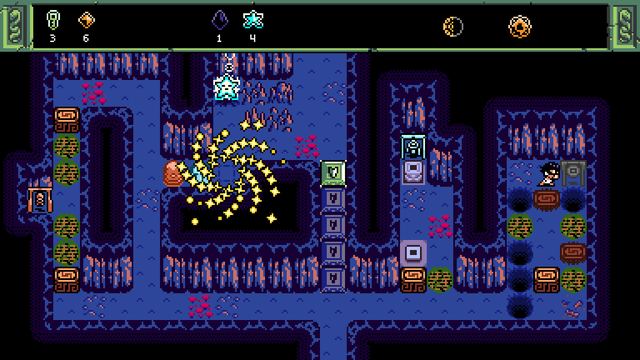
Snake eyes. In many rooms, snake statues stand watch. When a room still hides something, their eyes glow red. Eyes closed: the room is clean. Eyes red: keep pushing, keep looking. This is the single most useful habit in the game.
The secret mark. A small mark near a wall means a secret passage is close — usually triggered by a push that blows the wall open. Some passages lead somewhere real; some just change how a room connects. Push around the mark and find out.
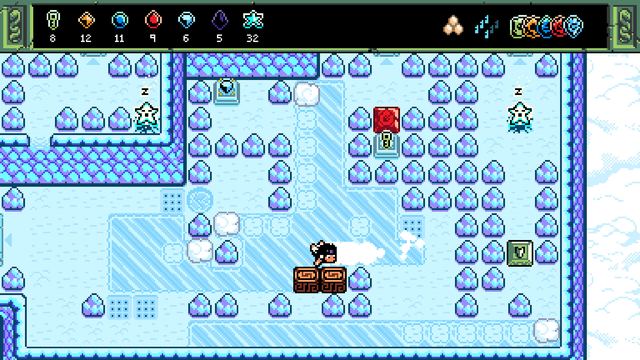
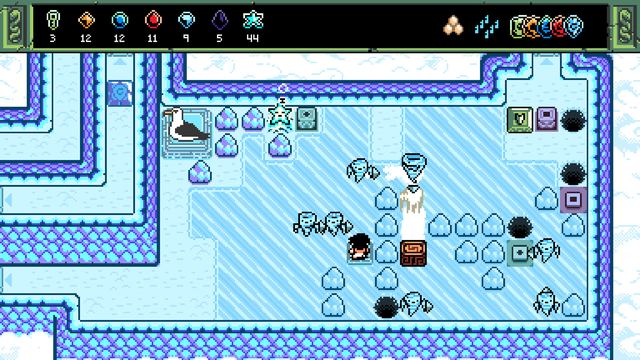
Music notes. A few blocks carry a nearly invisible music-note emblem (harder to spot on ice). The game also plays a sound cue and adds a faint tint when you enter a screen with an undiscovered note — two quiet safety nets.
No hints at all, sometimes. The community has confirmed at least one hidden passage (with an obsidian inside) that neither snakes nor marks reveal — on the island only reachable by giant bird, bottom-left of the map. And in general: if you can see something out of reach, the game is probably telling you that it is reachable. Be brave.
The wall writing
After the Mysterious Update, the islands write. The entry fee is the black crown on Serpent's Stack — reach it by pushing a normal block onto black smoke. With the crown, wall murals start resolving into readable glyph phrases:
- Read glyphs left to right; directions appear as footprints (the wider section points forward — it looks backwards at a glance).
- Symbols combine island + screen + action: "the big shape is the island, the small one with a dash is a little isle, the marks tell you which room and which corner".
- About half the symbol vocabulary lives on Serpent's Stack's opening screens, whose first screen doubles as a labelled world map — and the snake island has no in-game map of its own.
- Community tip: some phrases are written inverted relative to how they read on the map — if a route makes no sense, try the mirrored direction.
- The full symbol lexicon is community-maintained (the "Glyph Dictionary" on Steam is the reference with pictures).
The alphanumeric cipher
The other writing system is a straight A–Z, 0–9 cipher: letters are stylised shapes, numbers mostly count their own sides (6 and 9 look like 6 and 9). It surfaces in late-game codes — most famously the Frozen Spire A1 code, which turns out to read your save file's name.
The author's hidden room
At the bottom of Serpent's Stack there is a room the game never sends you to. Players cracked it with a clone trick: your clone triggers buttons slower than you do, so you can push a wind block out with the clone, use two winds to shove your own body past the ground spike — and arrive.
The reward is a message from the developer: "congratulations partner, you found a secret room! yup, i am afraid that is it... until the ??? update." The Chinese community documented the route with a video; the message is dated pre-Mysterious Update, which makes the "???" easy to read in hindsight.
The free tip everyone learns too late
When land-edge tiles look like a dead end at the screen border, they usually are not: walk off the edge — it connects to the neighbouring room. Platitudes aside, this one rule saves people hours.